Capturing Authentic Video Testimonials: The Key to Genuine Connection

Updated: Aug 17
Play most video testimonials, and you can feel the seams. A customer sits in a nicely lit room, hits their marks, and says the brand was "professional, responsive, and a pleasure to work with." Every word is true. But none of it moves anyone. It sounds like an ad wearing a customer's face. In a year when 75% of marketing video is AI-assisted, buyers have been trained to smell a script from across the room. The polished testimonial has quietly become one of the least persuasive things you can make. The fix is not a better camera or a tighter script. The fix is to stop staging praise and start capturing testimony.
The Tells of Fake Testimonials
Every fake has a tell. A bad forgery has a wobble in the signature. A lie has a beat of hesitation. And a hollow testimonial, whether it was over-directed by a crew or generated by a model, has the same tell: no feeling. The words check every box but land on nothing.
That instinct buyers have is not vague. In a 2026 survey, 83% of consumers said they had watched a video they suspected was AI-generated. The giveaways they named were not pixels or artifacts. They were human ones: robotic gestures, unnatural voices, and a lack of emotional tone. Read that last one twice. The thing audiences catch first is missing feeling. A testimonial that has been polished until the person disappears fails the exact same test as a synthetic one. Both are smooth. Neither is alive.
The Trap of Hollow Polish
"A testimonial that makes a real customer sound fake fails the same test as a fake one." This is the trap of hollow polish. When you sand a customer down to a clean, quotable soundbite, you also sand off the specific, slightly awkward, unmistakably real detail that made anyone believe them in the first place.
Testimony, Not Advertising
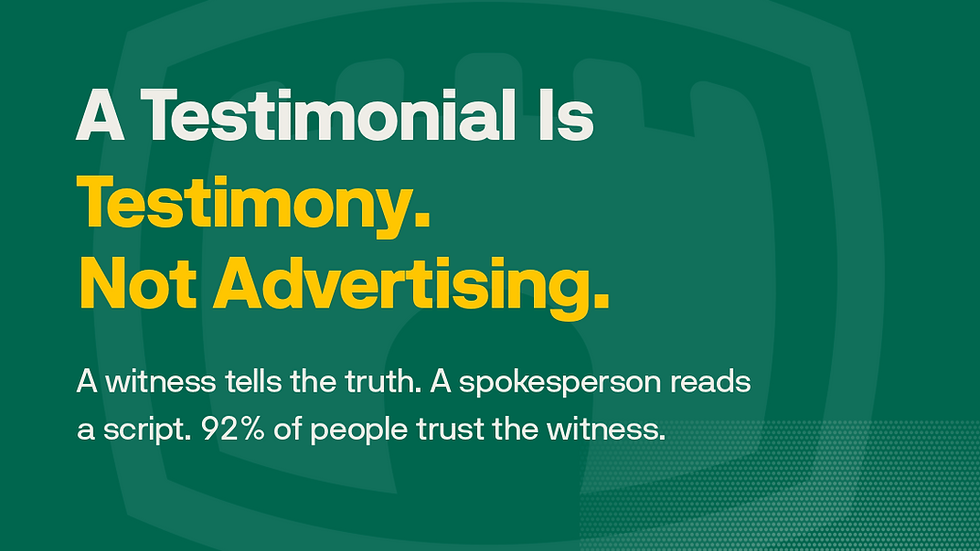
The word is the whole strategy. A testimonial is testimony. It comes from the witness stand, not the billboard. A witness does not sell you anything. They tell you what happened to them in their own words and let you decide what it means. The moment a customer stops testifying and starts advertising, you lose the one asset a competitor cannot copy and a model cannot fake: a real person who actually lived the result.
So, the job on set is not to extract praise. It is to earn testimony. That means asking about the before, not just the after. It means letting a customer find the words instead of feeding them to them. It means keeping the pause, the small laugh, and the moment their voice catches on the part that mattered. Authentic video marketing is not lower-effort than polished video. It is harder because you are directing toward truth instead of tidy, and truth does not always arrive on schedule.
None of this means abandoning craft. This is the line the whole approach turns on: the enemy is not production. Documentary-style storytelling, beautifully shot, is still lit, still composed, and still cut with intention. We are not trading a good camera for an iPhone and calling the shakiness "authentic." We are pointing filmmaker-level craft at a real moment instead of a staged one. Real, elevated by craft. Not raw for its own sake.

Why Authenticity Beats Automation
The market has already voted, and the numbers are not close. Roughly 92% of consumers say they trust a video testimonial more than traditional advertising. Nearly 78% say they trust videos featuring real people over AI-generated ones. In 2026, 87% trust customer and creator testimonials more than a brand's own polished claims. Meanwhile, 36% of consumers say an AI-generated video would actively lower their opinion of the brand that made it. Automation can scale a lot of things. It cannot scale being believed.
This is the head-and-heart split doing its usual work. Facts inform, but emotion is what makes a stranger act. Emotion is precisely the register machines and over-produced sets flatten. A real customer choking up over the thing that changed for them carries more selling power than any list of features. The viewer does not just hear the outcome; they feel it, and feeling is what memory keeps.
The strategic read is not "never use AI." Let automation carry the unglamorous load: transcription, rough assembly, subtitles, and versioning. Keep a real human visible and unedited in the frame that has to do the convincing. Documentary-style video is the format built for that division of labor. This is why authenticity, joined with craft, is the differentiator in an automated feed rather than a nostalgic preference.

What Testimonial Video Production Actually Requires
A customer story that a buyer believes is not an accident of a talkative subject. It is built, and it sits at the bottom of the funnel where doubt lives. Clarity beats creativity every time.
It requires knowing the one objection this video exists to remove. Price, risk, trust, "will this actually work for someone like me?" A testimonial aimed at everything reassures no one. It requires casting for truth over polish, choosing the customer whose story is specific rather than the one who is merely articulate. It requires interviewing toward a turn, the before-and-after that lets a viewer watch a mind change. A flat wall of compliments has no story in it. It also requires the restraint to cut the ten nice things they said and keep the one true thing because clarity beats completeness here too.
Do that, and a customer video testimonial stops being a trust badge you hope someone notices. It becomes the video that does the work your sales team cannot be in every room to do.

Proof: What Real Looks Like on Screen
We built Back On My Feet around a mission most crews would have shot literally and flattened: running as recovery. We told it as transformation, a real person moving from one life toward another. In that world, the change is the product. No line of copy could have sold what the viewer felt watching an actual human being reclaim their footing. The authenticity was the argument.
We made the same choice with Imagine A Way. We handed the film to the parents raising children with autism instead of to the organization. We let them say the unpolished, specific, true thing. A donor to that mission is not moved by a mission statement. They are moved by the relief on a mother's face when someone finally understands her week. That is what testimony looks like when you stop directing it toward tidy.
And in a boardroom instead of a living room, O'Connell Robertson's story still works the same way. The film we made with them is still used as a business-development tool. It opens rooms and warms prospects precisely because it sounds like the firm actually talking rather than a brand performing. Real travels further than polished in every vertical. A viewer's trust is built the same way everywhere: they believe people, not productions.
Point the Craft at the Truth
If your testimonials look expensive and convince no one, you do not need a slicker edit. You need to stop staging praise and start capturing a person. The craft is not the problem. Where you aimed it was.
Beautiful footage of a customer reciting adjectives is easy to buy and easy to ignore. A real story, elevated by real craft, that makes a prospect see themselves in the outcome is the rarer and far more valuable thing. That is the whole case for authenticity over automation. In a feed full of frictionless, forgettable, machine-smooth video, the human moment is the only one that stops the scroll and earns the trust.
We put the questions we ask into our Authenticity Scorecard for Your Next Video. It’s a quick way to check whether a story will read as real before you ever roll. And when you are ready to map where testimony fits across your funnel, our Video Marketing Audit & Discovery shows exactly where a believable customer story will move the numbers you care about.
Make the polished film if you want. Just make sure there is a real person left inside it because the polish was never what anyone believed.
Free Resource for Download