Brand Storytelling: How to Find the One Story Worth Filming

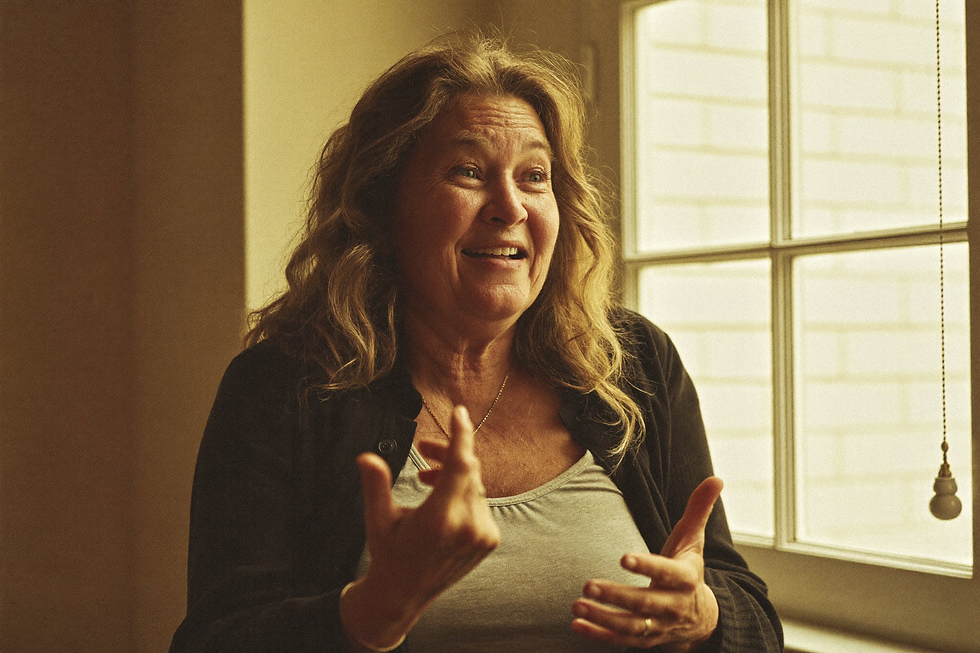
Twenty minutes into an interview, or fifty, after the talking points have been exhausted and the subject has relaxed into the chair and stopped performing for the room, they usually say something they did not plan to say. It arrives sideways, in the middle of an answer to a different question, and it is almost always smaller and stranger and more specific than anything in the creative brief. It is also, almost always, what the film will turn on.
People start where they are supposed to start, on the official language, which is safe and approved and true enough as far as it goes. Give them long enough and something else arrives, usually about what they are actually getting out of working there, and it is rarely opposed to the brand message so much as sitting underneath it holding it up. That is the surprise, and it nearly always comes after the wait.
The job is to find the thing that was already true and then get out of its way.

You Are Not Writing the Story. You Are Finding It.
There is an old line about sculpture, usually pinned on Michelangelo, that the figure was already in the marble and the artist's only real work was removing everything that was not the figure. It is a romantic idea about stone and a very practical idea about organizations, because the story you need is almost never something you have to invent. It is already sitting in your building, inside somebody's memory, in a moment a nurse or a program director has told at three dinner parties without once thinking of it as marketing.

This matters enormously if you have the budget for one film, which most organizations do, and which is a perfectly reasonable place to start. A film built on a found story will outperform a film built on a committee's summary of what the organization does, every time, for reasons the research below makes uncomfortable to argue with. You do not need a bigger budget to get a better film. You need a better hour with the right person.
You do not need a bigger budget to get a better film. You need a better hour with the right person.
What the Research Actually Says About Storytelling
The case for story is not a matter of taste. Keep these numbers close for the meeting where someone senior calls the emotional approach fluffy.
Start with memory. Chip Heath ran an exercise with Stanford students in which each gave a one-minute persuasive speech; on average the speakers used two and a half statistics apiece, and only about one in ten told a story. Ten minutes later, sixty-three percent of the audience could recall the stories, and five percent could recall a single statistic. Students in a classroom, listening on purpose, ten minutes after the fact.
Then the behavior. Paul Zak's lab at Claremont measured what happens neurochemically while people watch narrative video, and found that character-driven stories with emotional content reliably triggered oxytocin release, and that the amount released predicted how much of their own money subjects afterward gave to a charity connected to the story. A factual presentation of the same information did not. Feeling was not decoration on the way to the ask. Feeling was the mechanism.
Then the money. Les Binet and Peter Field analyzed nine hundred and ninety-six campaigns entered into the IPA Effectiveness Awards between 1980 and 2010, and found that emotionally led campaigns were close to twice as likely to produce top-box profit growth as campaigns built on rational messages like price and promotion. Rational messaging wins in the short term and is largely forgotten. Emotion compounds.
Binet and Field then ran the same question on B2B, for LinkedIn's B2B Institute. In the room where everyone is certain they decide rationally, they found emotional campaigns roughly seven times more effective than rational ones at driving long-term growth. The effect gets larger, not smaller. Mark Ritson calls it emotion with a small "e". It need not be heart-wrenching. It often works best understated. It just has to be there.
One more, because it changes how you cast the film. Deborah Small, George Loewenstein and Paul Slovic showed that people give more, and feel more, for one identifiable person than for a statistical group, even when the group is larger and the need is greater. The extension is the interesting part: ask people to solve arithmetic first and the effect disappears, because analytical thinking suppresses the sympathy that drives it. Open your film with a data slide and you have sedated the exact faculty you needed.
Facts inform. Emotion moves.
The two are not rivals,
and the best films earn the fact
by first delivering the feeling.
Where the Story is Hiding
Every sector buries its story somewhere different, and knowing where to dig is most of what experience buys you.
In healthcare, it is rarely the treatment and almost always the moment a frightened person decided to believe someone. Look for the hand on the forearm, not the accreditation.
In nonprofits, it is almost never the founder's origin story, which everyone on staff has heard too often to hear at all. It is the volunteer who came once and stayed nine years.
In higher education, it is the doubt that came before the acceptance letter. Nobody remembers a ranking. Everybody remembers the student who was certain she did not belong. In professional services and AEC it is the project nobody else would take, and in tech and energy it is never the technology but the person downstream of it, three counties away, whose day changed because of a decision made in a room they will never see.

There are universal hiding places too: the moment somebody almost quit, the reason somebody stayed when the sensible thing was to leave, and the story a leader tells at dinner but would never put in a brochure. That last one is nearly always what the film turns on.
Five Questions That Surface It
You can start this yourself this week, without a crew and without clearing an afternoon. Each of these stands on its own, so ask one over coffee or ask all five and record audio on your phone.
1. When has the work here been hard enough that you thought about giving up on it, and what got you through? This one hunts a turning point. Stories need a before and an after, and organizations have a habit of describing themselves entirely in the present tense.
2. When you think of the hardest project you have been part of here, who was the person who got you and your team through it? This is the casting question. It converts a program into a face, and the research above says the face is worth considerably more than the program.
3. What did you believe about this work when you started that you do not believe now, and what changed your mind? A change of mind is the most honest structure there is, and a leader willing to admit one becomes instantly more credible than a leader who is not.
4. When you tell someone outside of work about this place, what is the detail you always mention? People self-edit hard in business settings and stop self-editing almost entirely for this question. It is the one that most reliably turns up the line that ends up in the film.
5. Of everything that has happened here, what is the one thing you would still remember if you forgot all the rest, and what feeling comes with it? Not know. Feel. Write that answer down before anybody writes a script, because it is the only reliable test of every creative decision that follows.
Then the craft note that matters more than the questions themselves: once they answer, do not speak. Count to five and let the silence sit there being uncomfortable. The first answer is the prepared one, assembled from the website and the last board meeting. The second, the one that arrives to fill the quiet, is almost always the real one. Nearly every good line we have ever cut into a film came second.
How to Tell It Once You Have It
One person. One turn. One feeling. That is the whole structure, and it holds at thirty seconds and at thirty minutes.
A story about "the families we serve" is a category and moves nobody, while a story about a woman who kept a bus transfer in her wallet for six years is a person, and the bus transfer is the reason anybody believes the rest of it. Reach for the detail that could only be true of this one human being, because that is precisely the detail a competitor cannot copy and a machine cannot invent.
Keep the ratio honest at roughly eighty percent heart and twenty percent head. The facts, the credentials, the outcomes and the numbers your board watches all belong in the film, but they belong in the last third, arriving as confirmation of something the viewer already feels rather than as the argument itself.
And keep the roles straight. The person you filmed is the hero, your organization is the guide who made the rescue possible, and the instinct to slide your own logo toward the center of the frame, which shows up in almost every review cycle with a perfectly reasonable justification attached, is the most common way a living film gets flattened into an artifact. Resist it once and the film survives.
How to Know You Found the Right One
Three tests, all free.
The stranger test. Could somebody with no connection to your organization repeat this story to a friend an hour later? If not, you have information rather than a story.
The dinner-party test. Would the person it happened to tell it unprompted, to people who do not care about your sector at all? Real stories travel on their own legs.
The subtraction test. Strip out every proper noun, every program name, every statistic, every logo and every credential, and then read what is left: if there is still a human being in there wanting something and not yet having it, you have a story, and if the whole thing collapses into nothing the moment the branding comes off, then the branding was carrying it all along. Branding has never been able to carry that weight.

One Film, Told Truly, is Enough to Start
There is a version of this advice that ends by informing you that one video is never enough and that what you really need is an entire system, and while a mapped funnel is a genuinely powerful thing that we build for clients all the time, it is not what most organizations are ready to buy on a Tuesday, and it is not an honest answer to the question you actually asked. You have budget for one film. Make it a true one.
Which is exactly why the second half of this work matters, and it costs an afternoon rather than a retainer. Before you decide which story to tell, find out where people are getting stuck on the way to you. Are they never hearing about you at all? Finding you and not understanding what you do? Understanding and not believing you? Believing you and still not moving?
Those are four different problems, and a story that solves one will not solve the others. Someone who has never heard of you needs to feel something before they will spend attention on a detail. Someone comparing three options wants specifics and proof. Someone standing at the decision needs their last doubt named out loud and answered before they sign. Same organization, same found story, and a different cut, opening and closing line depending on which of the four you are making it for.
So run both halves. Find the true story sitting in the building, find the one place in the journey where your people keep stalling, and build the film where those two things meet. A film aimed at a real stuck point has a far better chance of moving a number than a film aimed at everyone, and it costs exactly the same to produce. It also earns the right to the next conversation, because it does the one thing a summary never does: it gives people a reason to bring you up.
If you want a second pair of eyes on the story you are already sitting on, and on where your journey is quietly leaking, book your Castleview Blueprint, a video marketing audit and discovery session. Thirty minutes, no pitch, no obligation, and every so often the honest recommendation is to point a phone at one person and skip the crew entirely.
Somewhere in your organization there is a person carrying the sentence you have been trying to write.
Go find them.
---
Sources:
Chip and Dan Heath, [*Made to Stick*](https://heathbrothers.com/books/made-to-stick/) (2007). Paul J. Zak, ["Why Your Brain Loves Good Storytelling"](https://hbr.org/2014/10/why-your-brain-loves-good-storytelling), *Harvard Business Review* (2014). Les Binet and Peter Field, [*The Long and the Short of It*](https://ipa.co.uk/knowledge/publications-reports/the-long-and-the-short-of-it-balancing-short-and-long-term-marketing-strategies/) (IPA, 2013) and *The 5 Principles of Growth in B2B Marketing* (LinkedIn B2B Institute). Deborah Small, George Loewenstein and Paul Slovic, ["Sympathy and Callousness"](https://www.sciencedirect.com/science/article/abs/pii/S0749597806000057), *Organizational Behavior and Human Decision Processes* (2007).