Documentary Style Video: Show Your Values, Don't Narrate Them

Updated: Sep 28
A Value is a Claim. A Moment is Evidence: Crafting a Compelling About Video
Creating an impactful About video is essential for any organization. It's not just about stating who you are; it’s about showing it. In this post, we’ll explore how to create an About video that resonates with viewers and effectively communicates your brand's mission and values.
Understanding the Difference: Claims vs. Evidence
"We put people first" is a true statement. However, it’s also a finished thought. A finished thought gives a stranger nothing to engage with. They can't verify it, picture it, or connect with it. Chances are, they've encountered similar phrases on multiple websites. As a result, it often goes unnoticed.
This doesn’t mean you shouldn’t express who you are and why you matter. That’s the core purpose of the video. Organizations that skip this step end up with three minutes of visually appealing footage that could belong to anyone. The mission, vision, and values must be addressed. The key question is whether the video asserts these values or proves them through real moments.
The Mission, Vision, and Values: Proving Your Worth
What Most About Videos Actually Are
Most About videos simply read the About page aloud. This approach is ineffective.
Picture this: a voice narrates over a slow pan through the lobby. It mentions the organization’s belief in putting people first. The camera glides down a hallway, capturing someone laughing at a desk—slightly too staged. Then, a line about commitment to excellence appears, followed by the logo.
While this may be beautifully shot, it’s frustrating. Real craftsmanship is wasted on sentences that lack substance. The script often starts from the values page instead of focusing on evidence. No amount of lighting can save a line that lacks depth. This isn’t a production issue; it’s a decision made long before the crew arrives, and it can be fixed beforehand.
The Importance of Evidence
"A value is a claim. A moment is evidence."
This principle is crucial when creating your About video.
What the Research Says About Claims and Scenes
The preference for scenes over assertions isn’t merely a matter of taste. It’s backed by research.
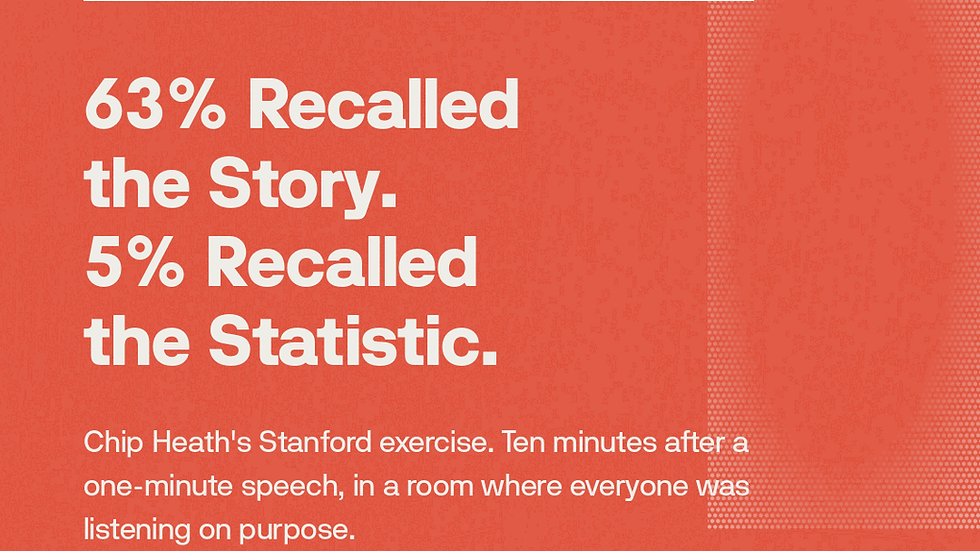
Start with memory. Chip Heath conducted an exercise with Stanford students, where each student delivered a one-minute persuasive speech. On average, speakers used two and a half statistics, and only one in ten told a story. Ten minutes later, sixty-three percent of the audience could recall the stories, while only five percent remembered a single statistic. This was in a classroom setting, where students were focused and engaged.
Then the mechanism. Research by Deborah Small, George Loewenstein, and Paul Slovic shows that people give more, and feel more, for one identifiable person than for a statistical group. This finding is significant for your script. When people are asked to do arithmetic before making a decision, the emotional connection diminishes. This same instinct appears when potential buyers decide whether to trust an organization.
Combining these insights leads to a vital rule for editing. One person doing one specific thing will resonate more than a paragraph of true statements about the entire organization. If you start with a claim, it may dull the emotional response needed to engage viewers. This is why opening with a scene and allowing the mission to unfold later is often more effective.
Where the Evidence Already Is
You likely already possess the material needed for your video. It just hasn’t been recognized as marketing. Inside the organization, it may seem like "just what we do."
Ask your team a focused question: What happened last month that people are still discussing? Avoid asking what you stand for, as that will lead you back to the values page. The timeframe matters. A year is long enough for everyone to recall the same legendary stories, while a month encourages specific, ordinary moments. These moments are what resonate as genuine on camera.
You’ll gather a range of responses, most of which will be small. That’s the desired outcome. Look for the moment that makes your mission clear to a stranger without needing to state it explicitly.
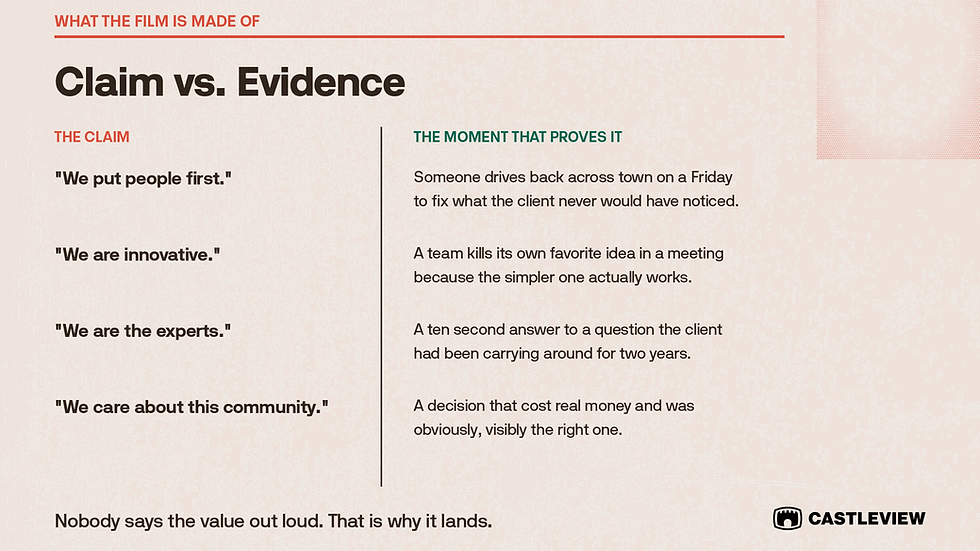
It could be someone driving back across town on a Friday to fix an issue the client wouldn’t have noticed. Maybe it’s the hour someone stayed on the phone after closing. It might even be a decision that cost money but was clearly the right choice. None of these moments mention integrity, yet they demonstrate it effectively.
The Test That Decides the Cut
Once you have identified potential moments, evaluate each one with a single question: If a stranger watched this without narration, what would they conclude about us?
If the honest answer is "that they work hard," but your actual differentiator is that you tackle projects no one else will, you have a nice moment that proves the wrong claim. Set it aside. The moment must convey the specific message you want to communicate, not just warmth, as warmth is something every competitor’s film also conveys.
This step distinguishes a documentary-style video from a collection of candid footage. Documentary doesn’t mean unplanned. It means the argument is built from real moments rather than being asserted over them. Choosing which real moment carries the argument is the most crucial decision in the project.
How to Judge the Cut You Get Back
You don’t need a filmmaker's vocabulary to assess whether your video succeeded. Start by watching the rough cut with the sound off.
If you can still discern what the organization values, the film is doing its job. The meaning should reside in the visuals. If the footage becomes generic the moment the voiceover stops, then the video relies solely on narration. In that case, you have an audiobook with pictures.
Next, hand the video to someone unfamiliar with the organization. Ask them what kind of place it seems to be. If they respond with an adjective from your values page that wasn’t explicitly stated, the evidence landed. If they say it appears professional, it didn’t.
Both of these tests can be conducted in twenty minutes without any technical expertise. They are far better indicators of how the film will perform than whether the color grade is stunning.

What This Looks Like When It Works
Take our work for Epiphany Dermatology as an example. The Physician of the Year profile was based on a simple principle: patients meet a person before they meet a practice. The film didn’t claim that the practice was caring; it showcased someone whose care was evident, allowing viewers to reach that conclusion themselves.
Similarly, the film for The National Domestic Violence Hotline raised over three million dollars in three years, according to client reports. Such results don’t stem from a well-crafted mission statement delivered over B-roll. They arise from putting viewers close enough to something real that the mission transforms from a claim into a witnessed reality. This shift represents a different psychological experience entirely, which is why this style of film continues to resonate long after the campaign concludes.
Don’t Delete the Mission Statement. Prove It.
Keep your values and vision. Display them on your website, in presentations, or on the wall by the front desk. A sentence is the right tool for that.
However, let the film do what a sentence cannot: immerse someone in the experience while it’s happening. Your About video doesn’t need better words; it needs evidence. That evidence is likely something that occurred last month, and your team is still discussing it.
Ask them tonight. You’ll be surprised at how quickly the right answer comes to light, and how rarely it resembles traditional marketing.
Want a second pair of eyes before you shoot? The Castleview Blueprint is a video marketing audit and discovery session. No pitch, no obligation, and sometimes the honest recommendation is not to shoot at all.